Building a resilient sales function

For businesses, if 2020 was about being as agile, resilient and focused as possible during the pandemic, then 2021 is about planning for the future. Continuing to drive sales activity in periods of change is critical to both survival and the long-term health of the business. So how do you build a more resilient sales organisation, keep your teams focused and motivated and prepare for the changes that are coming our way?
Overview
Underpinned by in-depth interviews1 with industry leaders and academics in the UK, Europe, Canada and further afield, in this article we will look at how you can build a more resilient sales organisation, whether you are a retailer adapting to an accelerated move to digital, a logistics firm adjusting to the shifting political landscape or a professional services firm facing a prolonged period of remote working.
A sales organisation is the part (or parts) of a business responsible for contact with customers and ultimately driving revenue.
The short-term outlook for the sector is strong. However, this is largely driven by sales of a single new drug, rather than a broader expansion of the sector. This creates uncertainty about the longer-term prospects for the region. Meanwhile, regulations, particularly at the European level, present a significant burden for companies, threatening to undermine the profitability of smaller players.
Do you know what your customers want?
It is a truism to say that the first step in selling is having a product that people want to buy. Staying ahead of changing customer dynamics is the first step in building a resilient sales organisation.
Start with three questions and revisit them regularly:
• Are my customers behaving differently?
• What environmental factors are driving any changes?
• Do I need to adjust my proposition to meet new expectations?
In some cases, the answers to these questions will be obvious, but where the answer is more subtle, the feedback loop from the sales teams and other customer intelligence is essential.
1. Hesmur Research: Market practices in driving greater sales resilience
Support in good times and bad
The culture of an organisation goes a long way to building resilience in turbulent times. In sales organisations, employee support and investment is doubly important in difficult times. The sales organisation is the closest point of contact with your customers but can also be the most severely impacted during difficult times due to high commission levels and variable compensation. Taking a long-term view and bolstering the sales organisation in times of difficulty not only helps make the best of the hard times, but also helps maintain customer relationships and prepare for the future.

Build a robust sales infrastructure (even if you don’t think you need it now)
There are four key elements to building a robust sales infrastructure:
In good times, few pay attention to how sales are happening if targets are being met. The pandemic brought several existing issues in many sales infrastructures into sharp focus and gave us several new ones for good measure.
The best sales leaders focus not only on communicating a clear vision of where the organisation needs to go but also on demonstrating a commitment to their people.2
2. McKinsey & Company: Five actions to boost your sales organisations resilience, July 1, 2020
1. People and capabilities
Assessing your sales force capabilities
• Do they understand the changing sales drivers for their customers?
• Are they aware of and understand all the products / suite of products they are selling?
• Can they work across all channels customers require (e.g. remote, face to face and digital if needed)?
• Are they able to build relationships with customers and stay engaged through long sales cycles, and over the life of the customer relationship?
• And most importantly, are they able to maintain customer understanding, core sales capability and deploy emotional intelligence, even in times where it is difficult to maintain a relationship?
Read more about developing digital EQ
2. Process management

While many view sales as a “dark art”, the crisis has underlined the importance of rigorous process management that keeps people focused on:
• the customer,
• opportunities that will bring the greatest value, and
• executing flawlessly when a sales opportunity does arise.
While technology has gone a long way in enabling and streamlining these processes, it is the focus on these core processes that has enabled firms to continue to serve customers and drive sales activities even in crisis situations.
3. Performance management
Many traditional sales performance management frameworks often only focus on tracking “wins on the board”. This binary approach fails to capture the richness of intelligence through the sales cycle that enables a more finely tuned and resilient sales organisation. Understanding the drivers of success (and failure!), whether it’s in identification, qualification, the ultimate sale or post-sales support and service, will add to the overall corporate intelligence and drive better sales decisions; in good times and bad.

4. Tools and technology
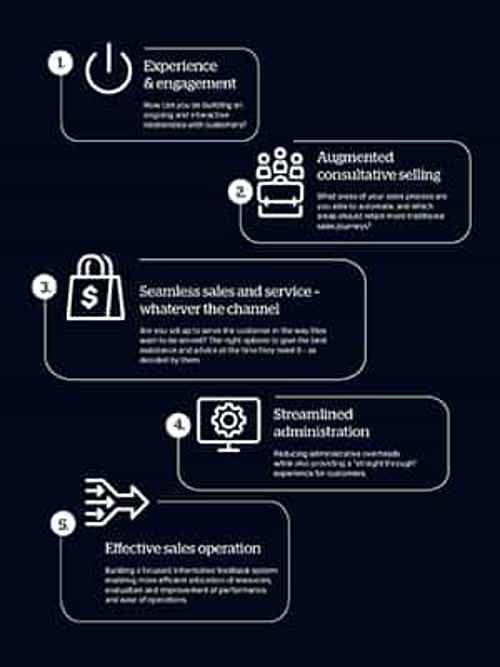
While most firms have evolved beyond the time when a sales infrastructure meant a rolodex and a company card, few outside of digital businesses fully take advantage of the available tools to augment their sales organisations and build greater resilience.
Our research has identified the following components of a robust sales technology infrastructure3.
Experience & engagement
Building an ongoing relationship with customers.
Augmented consultative selling
Automating and enabling more traditional sales journeys.
Seamless omnichannels sales and service
Serving the customer in the way they want to be served: D2C when it suits them, with the option for assistance and advice when they need it.
Streamlined administration
Reducing administrative overheads while also providing a "straight through" experience for customers.
Effective sales operations
Building a focused, informative feedback system that enables more efficient allocation of resources, evaluation and improvement of performance, and ease of operations.
Focused investment in core technologies
Ensuring the core investments in data and enterprise technologies are focused on driving greater customer understanding, experience and interactions.
3. Hesmur research: Building a digitally enabled sales function
Considerations for different types of businesses
While it is important for firms to be aware of how shocks will impact their entire sales organisation, many industries will have different “hot buttons” depending on the nature of their sales cycle (short / transactional vs. long/consultative) and the products and services they offer.
“Hot buttons” and focus areas
Product orientation
Transactional
Maintaining the ability to efficiently transact business regardless of the channel and deliver products to customers.
• ecommerce capabilities
• product delivery / distribution capabilities
Consultative
Maintaining a connection with customers and continuing to drive positive engagement and experience through the sales cycle even in periods of disruption
• remote engagement capabilities
• broader experience and engagement
Service orientation
Transactional
Maintaining the ability to efficiently sell, schedule and deliver services to customers.
• ecommerce capabilities
• Omni-channel scheduling and booking capabilities
Consultative
• ecommerce capabilities
• enhanced remote engagement and service delivery capabilities
• broader experience and engagement
Addressing today’s needs and preparing for the future
Nothing is more fundamental to business than being able to sell and deliver products and services to customers. While no one can truly predict the post-Covid 19 era or any other shocks we may encounter, we can prepare to meet them. As we’ve discussed in this article building greater resilience into your sales organisation is the first step.
Where to start:
• focus on the fundamentals and continuously reassess your ability to sell (and deliver products and services that meet your customers’ needs;
• work towards a nimble and focused sales culture, ensuring your sales organisation has the right support and tools;
• evaluate your sales infrastructure to ensure it has the rigour and flexibility to adapt to changing customer and market dynamics.
• identify your business’s hot buttons and associated focus areas.

Further reading
In our planning and executing in uncertainty article we outline questions firms can ask when faced with uncertainty. Regularly asking these fundamental questions will go a long way to building your ability to serve customers and drive sales activities.
The more agile your organisation is, the better it can react to situations that arise. Read about the four basics to creating an agile culture.